
The Age of Celestial Navigation
The book explores the traditional techniques used by mariners to determine their position using celestial bodies, including the Sun, Moon, stars, and planets.
"Mastering the sea begins with understanding the science that governs it."
Inclusive of all taxes · EMI available at checkout
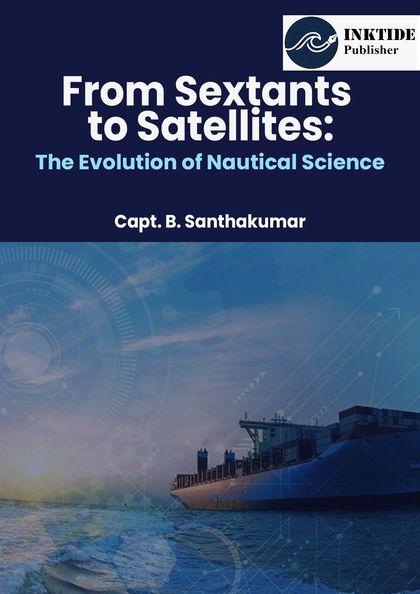
From Sextants to Satellites: The Evolution of Nautical Science explores the remarkable transformation of maritime navigation from traditional celestial methods to today's sophisticated satellite-based systems. The book traces how generations of mariners relied on observation, mathematical calculations, charts, and instruments such as the sextant to find their way across vast oceans, and how these practices evolved with technological advancement.
The book connects the foundations of traditional navigation with modern systems such as GPS, ECDIS, radar, AIS, satellite communication, and digital navigation technologies. It highlights how scientific progress has improved navigational accuracy, operational efficiency, and safety while emphasizing the continuing importance of fundamental nautical knowledge and professional judgement.
Whether you are a maritime student, a serving seafarer, or a curious reader drawn to the science and art of life at sea, this is a comprehensive and authoritative guide to seafaring mastery.
The book explores the traditional techniques used by mariners to determine their position using celestial bodies, including the Sun, Moon, stars, and planets.
It examines the importance of the sextant, nautical almanacs, chronometers, charts, and mathematical calculations in traditional ocean navigation.
The book traces the development of maritime navigation equipment from magnetic compasses and mechanical instruments to electronic and computerized navigation systems.
Modern navigation has transformed the bridge through technologies such as GPS, ECDIS, radar, AIS, and integrated bridge systems. The book explores how these technologies have changed the daily work of professional navigators.
The emergence of satellite-based positioning has provided mariners with unprecedented accuracy and continuous access to navigational information. The book examines its impact on modern seafaring.
Despite technological advancement, fundamental nautical knowledge remains essential. The book emphasizes the importance of understanding navigation principles, verifying information, recognizing system limitations, and applying professional judgement.
With increasing automation, digital connectivity, artificial intelligence, and autonomous vessels, maritime navigation continues to evolve. From Sextants to Satellites provides a perspective on where nautical science may go next.
From Sextants to Satellites connects the wisdom of traditional mariners with the technology of the modern bridge, demonstrating how centuries of navigational knowledge have laid the foundation for today's digital maritime world.
Explore the opening pages — tap page edges or use the arrows to navigate.
Own all 316 pages — the complete guide to maritime navigation, nautical science & the transformation of seafaring.
8Content layouts shown are illustrative sample representations — the published edition contains the full text and data visualisations.
After many years at sea, From Sextants to Satellites is the book I wish I had when I started. It connects scientific knowledge with practical seamanship in a way no other text has managed. The chapters on the human element and ocean understanding are particularly outstanding — essential reading for any serious mariner.
We have adopted From Sextants to Satellites as a recommended reference for our navigation and seamanship programmes. Capt. B. Santhakumar's ability to blend scientific rigour with practical experience makes this book uniquely valuable — students find it far more accessible than traditional textbooks, without sacrificing depth.
The section on seamanship and ship handling stands out as one of the best written explanations I have encountered in print. Capt. B. Santhakumar clearly understands what mariners face at sea, and the writing never loses sight of practical reality. One star held back only because I would love more coverage on autonomy and future navigation technologies.
Leave your details and we will email you the payment link and delivery details.